Showing posts with label Christianity. Show all posts

Wednesday, May 26, 2010

LOST and the Church

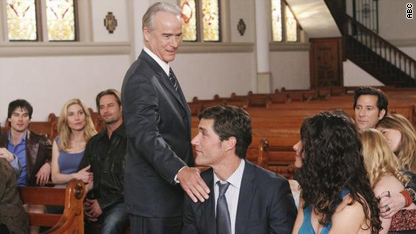
The television show LOST has captured the interest of many viewers over the past six years. The series finale, which aired on May 23rd, has polarized fans. The Sunday school class I teach at Crooked Creek Baptist Church hasn't focused specifically on LOST (yet!). But we certainly have focused on issues which have polarized Christians every bit as much as the LOST finale has polarized fans. And some of those topics are ones that LOST itself has explored: the meaning of existence, the nature of good and evil, the relationship of Christianity to other religions, and the afterlife.

I thus thought it appropriate to post on this topic, both to invite LOST fans in the Indianapolis area to a church that makes room for those sorts of conversations, and to share with friends at church (as well as anyone else who is interested) links to things I have written and interviews in which I am quoted commenting about LOST.

USA Today: "God, the Devil and TV's 'Lost'"
MTV News: "'Lost' Finale: Experts Talk Impact Of Religion On The Island."
E! Online: "Can the Lost Finale Satisfy the Fans?"
Journal Sentinel: "To The End, Fans Lost in TV's 'Lost'" and "Lost Theories Revealed" 

I have also blogged extensively about LOST for the past several years on my own personal blog, Exploring Our Matrix.

Whether you are a LOST fan or not, Crooked Creek Baptist Church welcomes you to join us for worship, and for conversation about interesting and important topics!

Sunday, May 17, 2009

Introduction to Islam

To facilitate our discussion of how Christians might/should view other religions, we realized that many need or would benefit from an introduction to some other major religious traditions. Today we began with Islam, and just barely scratched the surface.

We will continue next time, and those who will be attending and who have specific questions and/or topics of interest they would like to be covered/addressed are encouraged to let Dr. McGrath know ahead of time. One easy way to do so is simply to leave a comment here!

Sunday, May 3, 2009

Christianity and Other Religions

A thought that has come up in the series about "When Christians Disagree" time and again is that most of would agree that it is OK to agree to disagree about non-essentials. What we really disagree about is what those essentials are, and on what basis they are to be identified. And so, after asking about that and how we figure out what is essential, in Dr. McGrath's Sunday school class today we found ourselves talking about Christian identity and other religions.

Among the subjects we discussed was whether Christian identity is a matter of doctrine, practice or both. It was pointed pointed out that conservative Christians and Muslims would agree over against many liberal Christians in believing in the virgin birth. We also discussed whether it makes sense for Christians to think of Muslims as "worshipping a different God", or whether it makes more sense to acknowledge that the belief in one supreme deity is something held in common, while we may disagree about certain details of our doctrine about God. Over the coming weeks we'll be thinking more about the subject of the relationship between Christianity and other religions, and how Christians might/should view those religious traditions. In the mean time, Dr. McGrath shared what he calls the flaming meteorite test, as well as introducing the notions of exclusivism, inclusivism and pluralism.

At the end of May, Dr. McGrath's class will take a hiatus so that all its participants can attend the Sunday school class Pastor Bartley will be teaching about "Being Baptist".

Sunday, March 22, 2009

Leviticus 17-20 and Homosexuality

Today in Dr. McGrath's Sunday school class, we continued our discussion of homosexuality. Today's class began by focusing on the section of Leviticus that includes its two mentions of the prohibition against "lying with men the lyings of women", usually understood to prohibit same-sex male intercourse.

It was crucial to begin by pointing out that some of the things in this part of Leviticus we do not consider necessary. And in spite of slogans that affirm belief in the whole Bible, it should be clear to those who have actually read the whole Bible that those who claim to do so in fact don't. We need to be honest that we not only are not doing everything the Bible says, but deep down we don't think that we should. And so a key question becomes was whether there is any underlying rationale for why some things continue to be practiced while others do not.

One route that is sometimes followed is to defer the matter to the New Testament: those things that are reaffirmed there remain in force, those things that are set aside there do not. But apart from the question of whether all the New Testament authors agreed about what did and did not remain in force, it must be asked whether there is an underlying rationale for what is and isn't maintained in the New Testament. We will, at any rate, discussion Romans 1-3 next time.

Whether we are dealing with homosexuality, shaving, tattoos or other subjects mentioned in this part of Leviticus, we are not given a clear rationale explaining why these things are prohibited. Sometimes attempts have been made to give a rationale - e.g. pork was prohibited to prevent disease, tattoos were prohibited because infection as a result was far more likely back then. But it must be asked whether such concerns are likely to have been in the minds of the Biblical authors.

A number of issues were touched on but set aside until we can consider them in their own right in a well-informed way. These included whether homosexuality's acceptance in society threatens traditional marriage, whether this is an issue about which Christians ought to agree to disagree, and whether, even if Christians agreed in viewing homosexuality as a sin, that would necessarily translate naturally into an attempt to impose Christians' views on others through legislation. The historic Baptist committment to the separation of church and state seems to point in a particular direction on this last point.

Perhaps the most important point to note, however, is how those who claim to be "defending traditional marriage" or "defending Biblical morality" in fact are picking and choosing in ways that suggest ulterior motives on their part. This part of Leviticus includes laws about honesty in business, payment of workers' wages, and treatment of foreigners living in one's territory. Why are such topics ignored by some in favor of a focus on homosexuality? Clearly it is not a desire to be faithful to the Bible that is at the heart of this, since the other matters mentioned are scarcely less pressing issues today. Why do those claiming to "defend marriage" not focus more on divorce, which is the subject of much clearer Biblical teaching and is more obviously a threat to heterosexual marriages? It seems obvious that there must be other motivating factors than those claims. Indeed, one possibility is that this simply reflects an instinct we all have, if we are honest, namely the tendency to focus on that which others are doing, to shift blame, find scapegoats, and see the shortcomings of others more clearly than our own. But on this matter the teaching of Jesus is clear: our focus ought to be on the beams in our own eyes, not on the splinters in others'.

Monday, September 1, 2008

Outside the Canon

Another subject that came up yesterday in Dr. McGrath's Sunday School class is the character of those writings that existed in the early Christian centuries but did not become part of the canon of Scripture. Possibly the best site to learn more about those other writings (some of which were excluded because they were deemed "heretical", but this is clearly not the case for all of them) is Early Christian Writings. I recommend it for anyone interested in exploring this particular subject further.

Sunday, August 10, 2008

When Christians Disagree: Introduction

In beginning a study series on "when Christians disagree", we ought to mention why some seem to find it so surprising that Christians do in fact disagree. For some, the reason this seems surprising is the impression they have been given that Christianity is (and/or ought to be) a single, monolithic entity that has a clearly defined and uniform set of beliefs and practices. For others, the reason might be the assumption that, at the very least, those Christians who agree on the Bible's authority ought to agree.

But in fact, the Bible is one of the reasons for Christians disagreeing, for a number of reasons. First, Christians do not all agree about what the Bible is. For some, it is "inerrant", and in popular speech that may be taken to mean that everything in the Bible is not only without error, but precise in detail. However, a look at a statement about Biblical inerrancy made by conservative scholars and theologians, such as the Chicago Statement on Biblical Inerrancy, makes clear that for those who study the Bible in detail and in depth, the concept of inerrancy needs to be carefully nuanced if it is to reflect what we find in Scripture. And of course, if one defines inerrancy without regard for what we find in the Bible, then that definition is being imposed on the Bible and thus has authority over the Bible. And since those who argue for Biblical inerrancy usually do so because they regard it as the ultimate authority, the result is a contradiction.

Others prefer to speak of "infallibility", which usually means that the Bible is trustworthy in everything it affirms about God and salvation, without necessarily being accurate in all details of botany or mathematics or science.

Still other Christians view the Bible as errant and fallible, the work of human beings who wrote out of the depths of their experience of God, but who were nonetheless not made to write perfectly. Some would go further and emphasize that Christianity is about following Jesus, not the Bible, and that claiming inerrancy as an attribute for anything other than God is idolatry.

Even when Christians agree about what the Bible is, they do not automatically understand it and interpret it in the same way. It may turn out that this is because the Bible does not always give a single definitive answer about a particular subject, and we must resist the temptation to choose some teachings and use them to dismiss others because "they can't possibly mean that because the Bible says this", since one could always start with the other set of passages and argue the reverse.

Even Protestants agree that experience, reason, and tradition also have a place in Christians' thinking about matters of doctrine and practice. And while it might seem ideal to emphasize that the Bible has primacy of place, in practice none of us reads the Bible before having been influenced by parents and teachers and our own personal experience.

Christian who emphasize the Bible's authority also do not as a result always spend time making use of scholarly resources such as commentaries that would help them understand the text.

Christians of the modern era, whether Liberal or Conservative, tended to emphasize that there is a single absolute truth, whether it was to be found by reason, experience or revelation. In the postmodern era, some deny that there is in fact an absolute truth. In response, the idea of "critical realism" has been developed, which means being committed to the notion that there is a real world, that there is such a thing as truth, while also humbly acknowledging that what I believe may not correspond to that truth, and certainly there is a strong chance it will not correspond perfectly and precisely.

In addition to the differences that result from our interaction with the Bible, new issues that arise also lead to differences. We see this happening in the early church as it wrestled with the issue of the status of Gentiles in this Jewish Messianic movement. Today, we are in a similar situation, unable to simply look up a passage in "2 Newton" and read the verse that tells how Christians should view stem cell research. Most Christians agree that one should identify principles which can then be applied to the new issue. But even if we agree on the relevant principle, we may not agree on its application.

Disagreements among Christians thus seem inevitable, and in my opinion (you are free to disagree!) this is a normal and ideally should be a positive thing. If church is not simply a place for the spiritually mature, but also a place for those who are new to the faith to be nurtured, then we should expect there to be different viewpoint, and members who are at different stages in their Christian experience. As a community of fallible human beings, when we read in Galatians of Paul rebuking Peter, it should lead us to reflect that if one of the closest disciples to Jesus, who was an eyewitness to his public ministry, and was according to Acts 2 filled with the Holy Spirit, if he (who some identify as the first Pope!) could be wrong, then how much more so can we? And if he wasn't wrong, then Paul, one of the authors of Scripture, was presumably wrong to think that he was! Either way, the characters in and authors of Scripture left a lot of examples that should lead us to humility. It might be ironic were we to repeat their words, confident that we are never in error in doing so.

The Bible encourages us to have a childlike faith. Often it is claimed that this is a faith that accepts whatever it is told without questioning. Clearly those who understand it that way have forgotten what it was like to be children, and have no children of their own. Children question everything, and are often painfully honest about the emperor not having clothes on, while adults play along in a facade of mutual self-deception. Hopefully in discussing subjects that Christians disagree about, we can have this naive honesty. Hopefully as well we can separate people from the opinions they hold, and emphasize that our disagreements need not automatically lead to conflict on a personal level.

As this series progresses, there is no illusion that we will all come to agree. But hopefully we will better understand why we disagree, and if we continue to do so, will do so for better reasons, having critically examined the issues, the evidence and the arguments on various sides. Since the Bible will have a key place in all topics, we had best turn our attention next time to the different views Christians have of the Bible, of what it is and of how it is to be interpreted and applied. We hope you can join us!

Sunday, August 3, 2008

Dr. McGrath's Sunday School Class Starting New Series

Dr. McGrath's class (formed from the combination of the earlier classes/small groups Friends.com and BASICS) will begin a new series a week from today, on Sunday August 10th. The subject will be "When Christians Disagree: Dealing with and delighting in our differences".

The first class in this series will introduce the general theme and solicit ideas for topics to be covered on subsequent Sundays. The first major topic will be different views of the Bible that Christians have.

Today's class will finish off the series on John's Gospel.