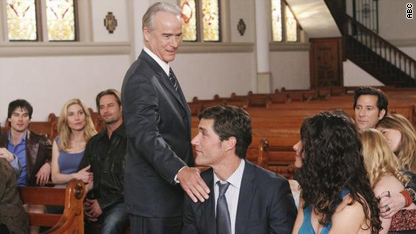
The television show LOST has captured the interest of many viewers over the past six years. The series finale, which aired on May 23rd, has polarized fans. The Sunday school class I teach at Crooked Creek Baptist Church hasn't focused specifically on LOST (yet!). But we certainly have focused on issues which have polarized Christians every bit as much as the LOST finale has polarized fans. And some of those topics are ones that LOST itself has explored: the meaning of existence, the nature of good and evil, the relationship of Christianity to other religions, and the afterlife.
I thus thought it appropriate to post on this topic, both to invite LOST fans in the Indianapolis area to a church that makes room for those sorts of conversations, and to share with friends at church (as well as anyone else who is interested) links to things I have written and interviews in which I am quoted commenting about LOST.
USA Today: "God, the Devil and TV's 'Lost'"
MTV News: "'Lost' Finale: Experts Talk Impact Of Religion On The Island."
E! Online: "Can the Lost Finale Satisfy the Fans?"
Journal Sentinel: "To The End, Fans Lost in TV's 'Lost'" and "Lost Theories Revealed"
I have also blogged extensively about LOST for the past several years on my own personal blog, Exploring Our Matrix.
Whether you are a LOST fan or not, Crooked Creek Baptist Church welcomes you to join us for worship, and for conversation about interesting and important topics!
Showing posts with label ending. Show all posts
Wednesday, May 26, 2010
Monday, April 13, 2009
Easter Sunday School
Yesterday's sermon focused on the ending (or lack thereof) of Mark's Gospel. The pastor compared Mark to a "choose your own adventure" story, particularly when it comes to the ending.
In Dr. McGrath's Sunday school class, we discussed this as well as another possibility, namely that the original ending of Mark's Gospel could have been lost. Papyrus manuscripts are easily damaged, and most of our ancient manuscripts from this period are significantly damaged. Although we have a great many relatively early manuscripts of the New Testament writings, including some on more durable types of "paper", it is not impossible that the earliest Gospel could have been damaged in some way.
The likelihood that the original ending was lost is increased when we consider that two different scribal traditions, as well as Matthew and Luke who used Mark as a source, felt it necessary to "improve" Mark's ending.
If one considers the different geographical locations for the resurrection appearance stories in Matthew and Luke, it seems impossible to argue for "inerrancy" in any meaningful sense of the term. But if one is asking not about inerrancy but about historicity, then a historian's approach can help us make sense of why Matthew and Luke diverge, with one having the disciples told to go to Galilee while the other has them told to remain in Jerusalem.
In 1 Corinthians 15 we find an example of the sort of tradition about resurrection appearances circulating a decade or more before the Gospel of Mark is thought to have been written. Dr. McGrath pointed out that no geographical setting is provided. And thus a plausible explanation for the divergence between Matthew and Luke is that neither had information on the setting of such appearances, and each independently turned the tradition into a narrative, locating it where it seemed to fit, with the resulting tensions when one has copies of both these Gospels.
Towards the end of the class, the Rev. Bartley brought up the question of whether a rationalistic, post-Enlightenment reading of the text is not alien to the worldview in which these writings were penned. Dr. McGrath replied that, on the one hand, he appreciates what reason and science have given to us. On the other hand, the attempt to require the text to provide certainty, or reject it if it fails to do so, is indeed at odds with these stories. Matthew's Gospel has the apostles doubting even after their "encounter" with Jesus. And so the desire for certainty is the desire for something that even the earliest Christians may not have had.
In Dr. McGrath's Sunday school class, we discussed this as well as another possibility, namely that the original ending of Mark's Gospel could have been lost. Papyrus manuscripts are easily damaged, and most of our ancient manuscripts from this period are significantly damaged. Although we have a great many relatively early manuscripts of the New Testament writings, including some on more durable types of "paper", it is not impossible that the earliest Gospel could have been damaged in some way.
The likelihood that the original ending was lost is increased when we consider that two different scribal traditions, as well as Matthew and Luke who used Mark as a source, felt it necessary to "improve" Mark's ending.
If one considers the different geographical locations for the resurrection appearance stories in Matthew and Luke, it seems impossible to argue for "inerrancy" in any meaningful sense of the term. But if one is asking not about inerrancy but about historicity, then a historian's approach can help us make sense of why Matthew and Luke diverge, with one having the disciples told to go to Galilee while the other has them told to remain in Jerusalem.
In 1 Corinthians 15 we find an example of the sort of tradition about resurrection appearances circulating a decade or more before the Gospel of Mark is thought to have been written. Dr. McGrath pointed out that no geographical setting is provided. And thus a plausible explanation for the divergence between Matthew and Luke is that neither had information on the setting of such appearances, and each independently turned the tradition into a narrative, locating it where it seemed to fit, with the resulting tensions when one has copies of both these Gospels.
Towards the end of the class, the Rev. Bartley brought up the question of whether a rationalistic, post-Enlightenment reading of the text is not alien to the worldview in which these writings were penned. Dr. McGrath replied that, on the one hand, he appreciates what reason and science have given to us. On the other hand, the attempt to require the text to provide certainty, or reject it if it fails to do so, is indeed at odds with these stories. Matthew's Gospel has the apostles doubting even after their "encounter" with Jesus. And so the desire for certainty is the desire for something that even the earliest Christians may not have had.
Subscribe to:
Posts (Atom)